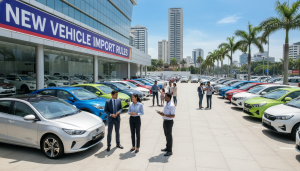
Vehicle Import Tax Changes Shake Sri Lanka’s Auto Market


The automotive sector in Sri Lanka faces a major economic shift. New government policy on levies for bringing in cars is now active.
This development is reshaping the landscape for consumers and businesses. Its effects are being felt across the nation today.
A report from the Parliamentary Committee on Public Finance (COPF) provides crucial context. It shows that fiscal revenue from this activity hit record highs in 2025.
That boom period, however, is not expected to last. Experts forecast a notable slowdown for the coming year.
This projection raises concerns about a potential fiscal gap. It presents a complex challenge for the country’s authorities.
The immediate impact on everyday people is stark and personal. For instance, the price of an average-sized car has doubled.
It has jumped from 2.5 million rupees to five million rupees. This change is directly tied to the new calculations for duties.
This article will serve as a guide to understanding this evolving situation. It will break down the specific adjustments and their wide-ranging consequences.
Introduction: A Market at a Fiscal Crossroads
The country finds itself at a pivotal financial juncture, driven by record-breaking collections from a single source.
An analysis by the Parliamentary Committee on Public Finance (COPF) provides the numbers. It shows that nearly Rs. 600 billion of the Rs. 1 trillion rise in total government earnings this year came from levies on brought-in automobiles.
This sum surpassed official forecasts by over Rs. 200 billion. The performance of this sector delivered a critical, yet potentially short-lived, fiscal windfall.
It highlights a significant challenge for authorities. They must now manage future revenue expectations amid signals of a predicted cooldown.
A key question emerges about the sustainability of this income stream. Demand for foreign-made cars and policy adjustments are historically volatile.
These record collections are deeply connected to the nation’s broader economic recovery efforts. They have been a major pillar of state finance recently.
The implications for the upcoming national budget are substantial. This context sets the stage for understanding the specific duty shifts detailed later.
This moment represents a true crossroads for fiscal planning and consumer access.
The 2025 Revenue Boom: A Windfall for the Treasury
A detailed parliamentary report reveals a revenue collection event of historic proportions. The COPF analysis shows the state collected an astounding Rs. 650 billion from levies on brought-in cars last year.
This figure shattered the official forecast of Rs. 450 billion. The actual intake exceeded expectations by a massive Rs. 200 billion.
COPF Report Highlights Record Tax Collections
The scale of the overshoot underscores an extraordinary fiscal period. It represented a dramatic jump from the Rs. 50 billion increase recorded just a year earlier, in 2024.
A major factor inflating these numbers was a temporary policy measure. Authorities had applied a 50 percent excise duty surcharge during this period.
This surcharge directly amplified the final tally. It turned strong demand into a record-breaking revenue stream for the treasury.
How Vehicle Imports Surpassed Revenue Projections
The tax boom was fueled by a significant volume of incoming cars. Financial data shows a high value of Letters of Credit opened specifically for this purpose.
This surge is largely attributed to pent-up consumer demand. After years of strict restrictions, improved economic access allowed a wave of purchases.
Many Sri Lankan buyers acted on long-delayed plans to acquire imported vehicles. This created a one-time spike in activity that propelled collections.
Experts consistently frame 2025 as an exceptional year. They caution that such a performance is unlikely to be repeated under the current economic climate.
The market experienced a unique convergence of factors that may not align again soon.
Forecasting a Slowdown: Why 2026 Looks Different
The Parliamentary Committee on Public Finance projects a significant cooldown for the next fiscal year. This marks a stark departure from the record-breaking collections recently witnessed.
Analysts point to a combination of financial tightening and shifting consumer behavior. These factors are set to reshape the landscape for brought-in automobiles.
Projected Drop in Import Volume and Tax Revenue
Official estimates for 2026 present a more restrained outlook. Tax revenue from this sector is expected to fall to around Rs. 550 billion.
This compares to the historic Rs. 650 billion collected the previous year. The total value of incoming vehicles is also forecast to decline.
It is projected to drop from US$ 1.5 billion in 2025 to $1.2 billion. This decrease signals a normalization after an exceptional period of activity.
A pipeline of transactions from late 2025 provides some short-term buffer. By October, $1.8 billion in Letters of Credit for these purchases had been opened.
Only $1.2 billion had been cleared at that time. The uncleared amount may lead to some activity in early 2026.
It is not expected to sustain the high levels seen before.
The Role of Saturated Demand and Tighter Financing
Two powerful forces are driving this anticipated slowdown. The first is a fundamental shift in consumer access to credit.
Financial institutions have reduced the Loan-to-Value (LTV) ratio for motor cars. It has moved from 60 to 50 per cent.
This change makes loans more expensive and harder to obtain. Buyers now need a larger down payment, which suppresses fresh imports.
The second force is simple market saturation. The 2025 surge represented a release of pent-up demand.
Many willing buyers with the means to purchase have already done so. This fulfilled demand leaves fewer customers in the immediate pipeline.
The combined impact is clear. Tighter credit and a smaller pool of ready buyers create strong headwinds.
This situation presents a complex challenge for national fiscal planning. The government’s budget may need to account for this volatile revenue stream.
The era of explosive growth appears to be giving way to a period of consolidation.
Breaking Down the Key Tax Adjustments Driving the Change
Understanding the dramatic price increases requires a close look at the specific fiscal instruments now in play. A car’s final cost is built from several layered government charges.
Each levy contributes to the total amount paid at the showroom. Recent policy moves have altered this formula significantly.
The Temporary Excise Duty Surcharge and Its Fate
A major driver of last year’s record collections was a temporary add-on. The government applied a 50 per cent surcharge on top of the standard customs duty for excise.
This policy caused excise duty collections to swell to Rs. 396 billion in 2025. It was a powerful, one-time boost to the treasury.
The surcharge’s future is now a central question. If it is not extended, excise revenue is expected to fall sharply.
Projections for the coming year show a drop to around Rs. 266 billion. This anticipated decline is a key part of the wider fiscal slowdown.
Introduction of the Special Sales and Turnover Tax (SSCL)
To manage the expected revenue gap, a new levy is being introduced. Budget 2026 creates a Special Sales and Turnover Tax, or SSCL.
This permanent tax will be set at 2.5 per cent on applicable transactions. It is scheduled to take effect from April of the coming year.
The SSCL represents a strategic shift. It aims to partially offset the income lost if the larger temporary surcharge lapses.
Stability in VAT and Luxury Vehicle Taxes
Amid these changes, some components are holding steady. The rate for Value Added Tax (VAT) on brought-in goods is not seeing a major shift.
The same is true for the luxury levy applied to higher-end models. This provides a measure of predictability for those specific cost factors.
However, the overall effect is cumulative. Each layer—customs duty, excise, surcharge, VAT, luxury tax, and the new SSCL—stacks onto the base price.
This compounding effect is what ultimately doubles the cost for consumers. It turns an affordable price into a significant financial commitment.
Direct Impact: How Tax Changes Are Doubling Car Prices
The real-world consequence of fiscal policy is often felt most acutely in the showroom, where sticker prices tell a stark story. “We have been waiting to purchase a vehicle for a long time. But if we calculate the tax and the price, the cost of an average sized car has doubled from 2.5 million rupees to five million rupees,” a consumer told the BBC. This sentiment echoes across the nation.
From 2.5 Million to 5 Million Rupees: A Consumer’s Story
This buyer’s experience is not unique. It represents a fundamental shift in affordability for many in Sri Lanka. The dream of owning a personal car has moved further out of reach for a significant portion of the population.
The dramatic jump is a direct result of recent fiscal adjustments. It transforms a major purchase from a planned investment into a financial challenge.
The Compound Effect of Multiple Tax Layers
The doubling of cost is not due to one single, massive levy. Instead, it is the result of several government charges applied one after another. Each new tax is calculated on a value that already includes the previous duties.
This “compound effect” multiplies the final price far beyond the original cost. To understand, consider a hypothetical car with a CIF (Cost, Insurance, Freight) value of 1.5 million rupees.
Here is a simplified step-by-step breakdown:
- Base Value: The car lands at a port valued at Rs. 1.5 million.
- Customs Duty: A percentage is added to this base value. This creates a new, higher amount.
- Excise Duty & Surcharge: The excise duty, plus the temporary 50% surcharge, is calculated on the value from step 2.
- Value Added Tax (VAT): VAT is then applied to the cumulative total from step 3.
- Special Sales Tax (SSCL): The new 2.5% SSCL is levied on the ever-increasing value.
- Luxury Levy: For higher-end models, an additional luxury tax is applied.
By the final step, the original 1.5 million rupee value can easily reach 3 million rupees or more. Dealership margins and other fees then push the showroom price toward the reported five million rupee mark.
This compounding mechanism explains why moderate-sounding tax rates lead to drastic retail price hikes. It severely limits the pool of buyers who can participate in the market today.
The result is a powerful link between policy and purchasing power. As affordability shrinks, the slowdown in consumer activity predicted for the coming year becomes inevitable.
Market Saturation: The End of the Pent-Up Demand Spike
Industry observers point to a simple truth: the pool of ready buyers has largely dried up. The dramatic surge in activity last year was not a new normal. It was the release of demand stored up over several years of restrictions.
During that period, many people postponed their plans to acquire personal transport. When conditions improved, a wave of purchases followed. This created the record-breaking numbers for brought-in cars.
The demand was particularly strong in the premium and luxury segments. Buyers with immediate financial capacity acted swiftly. Many have now completed their transactions, leaving this segment saturated.
A typical replacement cycle for personal vehicles in the country is several years long. This means a new wave of demand from these same buyers is not imminent. The market must now wait for a fresh cycle to begin.
This saturation represents a natural correction. Every boom is followed by a period of consolidation. It is not necessarily a sign of long-term decline for the automotive sector.
Current economic conditions may prolong this phase. Levels of disposable income and overall consumer confidence play a key role. Until these factors improve significantly, the pace of new orders will likely remain subdued.
A Colombo-based importer noted that the frenzy of 2025 is over. The industry is now adjusting to a more measured pace. Inventories at dealerships are beginning to reflect this new reality.
The exhaustion of pent-up demand is a primary reason for the projected slowdown. It directly suppresses fresh imports and contributes to growing stockpiles. This sets the stage for the next challenge facing the local trade.
Dealer Perspectives: Rising Inventories and Cautious Imports
For local distributors and sellers, the market’s slowdown translates into a tangible business challenge: mounting unsold stock.
The frenzy of last year has been replaced by a cautious mood. Showroom floors are no longer clearing out as quickly as new models arrive.
Stockpiles Grow as New Orders Slow
Businesses that bring in automobiles are now holding larger stockpiles. This buildup could reduce the volume of new arrivals for months to come.
A Colombo-based trader confirmed this shift. “Many buyers who could afford to purchase completed their transactions last year,” they noted.
This fulfilled demand means fresh orders from overseas suppliers are slowing down. Principals abroad are receiving more cautious requests from their local partners.
The financial pressure of holding expensive inventory is a key reason. Dealers face several direct costs that strain their operations.
- Financing charges on loans taken to pay for the stock.
- Storage and insurance fees for keeping units secure.
- Depreciation risk as models age on the lot.
Industry sources, like the Sri Lanka Vehicle Importers Association, highlight these pressures. To clear existing stock, many showrooms are now offering discounts or promotional packages.
This creates a potential short-term opportunity for buyers. A buyer’s market may emerge as dealers become more willing to negotiate.
This dealer caution is a direct driver of the projected drop in import volumes for 2026. When sales slow and costs rise, the logical business move is to order less.
The perspective from the showroom floor is a key indicator of overall market health. It shows how sentiment translates into hard numbers for the nation’s economy.
Consumer Alert: The Hidden Risks of Unofficial Vehicle Imports
Industry leaders are sounding the alarm on a growing trend that poses significant risks to unwary buyers. As prices from official channels rise, some consumers are looking elsewhere.
This search for lower upfront cost can lead to the parallel market for personal transport. Established trade bodies urge extreme caution here.
Warnings from the Vehicle Importers Association
The Vehicle Importers Association of Sri Lanka has issued clear guidance. It stresses the dangers of purchasing through non-authorized channels.
“Buyers might see a tempting price tag today,” a leading member told the Sunday Times. “But they could be inheriting serious mechanical and legal problems tomorrow.”
The association represents reputable businesses that bring in cars. Their warning is a matter of consumer protection.
Unofficial or “gray” imports bypass the official dealer network. This means the transaction lacks standard safeguards.
Potential Pitfalls: Accident Histories and Fake Mileage
The specific dangers are numerous and costly. A lower purchase price often masks hidden defects.
Key risks identified by the importers association include:
- Undisclosed accident damage: The car’s frame or safety systems may be compromised.
- Rolled-back odometers: The displayed mileage is fake, hiding true wear and tear.
- Counterfeit components: Non-genuine parts may fail prematurely and lack warranty.
- No manufacturer support: You cannot access official service networks or recalls.
Verifying a car’s history is very difficult in these cases. There is often no reliable paperwork.
The short-term savings can vanish with one major repair. Safety is also a genuine concern with a structurally damaged car.
Purchasing from an authorized dealer is an investment in reliability. It ensures access to genuine service and legal ownership documents.
For any major purchase, checking the seller’s credentials with the Vehicle Importers Association Sri Lanka is a smart first step.
Regulatory Hurdles: New Compliance Challenges for Importers
Two specific policy adjustments introduced last year continue to reshape the operational landscape for established dealers. Beyond financial calculations, businesses face a maze of revised rules.
Keeping up requires constant adaptation and increases overhead. This adds another layer of complexity to an already volatile trade environment.
Changes in Vehicle Age Calculation and Customs Duty
A key shift concerns how officials determine the age of a used automobile. The rule now uses the manufacturing date, not the date it arrives in the country.
This change affects classification and the final levy applied. A car built several years ago but shipped recently is now categorized as older.
This can push some models into a higher duty bracket or make them ineligible. It forces importers to be far more meticulous in sourcing and documentation.
Compounding this, the effective customs duty rate was raised to 30 per cent from February 2025. This directly increased the landing cost of every unit.
The combined effect is significant. A used model’s final price is now driven by its factory year and a higher base tariff.
Increased Operational Costs and Adaptation Struggles
The procedural changes place a heavy burden on company operations. Legitimate businesses must invest time and money to stay compliant.
This translates into several new costs and tasks for the industry.
- Detailed documentation: Proof of manufacture date is now critical, requiring new checks with overseas suppliers.
- Revised software systems: Internal costing and inventory programs need updating to reflect the new age logic.
- Staff retraining: Employees handling clearance must learn the updated regulations to avoid costly errors.
A Colombo-based trader highlighted the struggle. “Every month there seems to be a new detail to verify. It’s not just about the money anymore; it’s about the paperwork and getting it exactly right,” they explained.
This constant adaptation diverts resources from core business work. The cumulative effect squeezes profit margins for importers.
These compliance costs ultimately feed into the final price for consumers. Regulatory adherence is a real, if often unseen, component of a car’s showroom tag.
For the legitimate trade, navigating these hurdles is now part of ensuring business viability in the current climate.
The Government’s Revenue Dilemma for 2026 and Beyond
The historic windfall from levies on automobiles has placed the treasury in a paradox of plenty and precariousness. Record collections have provided vital funds, but their future is now in question.
The Parliamentary Committee on Public Finance (COPF) offers a clear warning. It states the sector’s role in national fiscal stability remains highly volatile.
Policymakers must tread carefully. Consumer behavior, regulatory shifts, and market demand will dictate how much the state can rely on this income next year.
Balancing Fiscal Needs with Market Realities
A core challenge for the government is choosing between two difficult paths. One option is to extend temporary measures like the 50 per cent excise surcharge.
This would help maintain high revenue levels to fund the national budget. However, it risks suppressing the market further by keeping consumer prices elevated.
The alternative is to let the surcharge lapse as planned. This would likely ease pressure on buyers and could stimulate some demand.
Yet it would create a significant fiscal gap. The country would need to find other sources to cover that shortfall.
This dilemma highlights the tightrope Sri Lanka‘s financial planners must walk. They must weigh immediate treasury needs against the long-term health of the automotive trade.
Can the SSCL and Other Taxes Fill the Gap?
The new Special Sales and Turnover Tax (SSCL) is a key part of the strategy. Set at 2.5 per cent, it is designed as a permanent levy starting in April.
Its goal is to partially offset the expected drop from the excise surcharge. Stable streams like Value Added Tax (VAT) and luxury taxes will also contribute.
Analysts are assessing whether this combination can fill the potential void. Projections suggest excise revenue could fall by around Rs. 130 billion if the surcharge ends.
The SSCL and other stable taxes may not fully cover that amount in the coming year. This points to a likely revenue decrease from this sector for the 2026 budget.
The situation underscores the COPF’s warning about volatility. Relying too heavily on one sector is a risky strategy for Sri Lanka.
A more balanced and diversified government income approach is needed. This is especially true given commitments under international financial programs.
Other revenue-raising measures across the economy will be crucial. The decisions made now will directly shape fiscal outcomes for the country next year.
The tax regime for brought-in cars is at a pivotal point. Its future will be defined by the trade-offs between state finance, market vitality, and consumer welfare.
Navigating the New Market: Guidance for Prospective Buyers
With shifting policies and prices, consumers need a clear roadmap for their next automobile acquisition. This environment demands careful planning and research.
Smart decisions can protect your investment and ensure safety. The following guidance offers practical steps for any serious buyer.
Evaluating Authorized vs. Unofficial Imports
Your first and most critical choice is where to buy. Purchasing from an authorized dealer is the safest path.
As reported by the Sri Lanka Vehicle Importers Association, unofficial channels pose serious risks. These include hidden accident damage and tampered odometers.
Genuine spare parts and manufacturer warranties are often unavailable. Verifying a seller’s credentials is a essential step.
Check if the company is a member of the official importers association. Reputable transport dealers will provide full documentation.
This due diligence is your primary shield against fraud. It ensures legal ownership and access to service networks.
Timing Your Purchase in a Volatile Tax Climate
The question of when to buy is complex. Current dealer stockpiles may offer negotiation room.
Some showrooms are discounting to clear inventory. This could present a short-term opportunity.
However, major fiscal announcements are pending. The new Special Sales Tax (SSCL) takes effect in April.
The fate of the temporary excise surcharge is also unclear. Waiting a few months might bring tax clarity.
Stay informed by monitoring official gazettes and trusted news archives. Outlets like the Sunday Times provide reliable updates.
Understanding these timelines helps you avoid buying just before a potential price increase or drop.
Factoring in Long-Term Costs Beyond the Sticker Price
The showroom price is only the beginning. True cost of ownership involves several ongoing expenses.
Smart buyers calculate these factors for their budget.
- Insurance Premiums: Coverage for imported vehicles can be higher. Get quotes before committing.
- Spare Parts & Service: Ensure genuine parts are available locally. Their cost affects maintenance.
- Fuel Efficiency: Consider mileage, especially with fluctuating fuel prices in the country.
- Resale Value: Models with good service history and parts access hold value better over times.
Always conduct a thorough pre-purchase inspection. A professional mechanic can identify hidden issues.
Request a full vehicle history report if available. A comprehensive test drive is non-negotiable.
This work upfront prevents costly surprises later. It applies even when buying from authorized channels.
For many Sri Lankan families, this is a major financial commitment. Taking these steps empowers you to navigate the market with confidence.
Reliable information is your best tool. Consult updated sources before making any final decision.
The Road Ahead: Adaptation in Sri Lanka’s Automotive Landscape
Moving forward, all participants in this sector must navigate a new reality defined by higher costs and more cautious consumption. The dramatic price increases for personal transport and the projected slowdown in related state income are the defining features of this shift.
This situation demands adaptation. Everyday buyers are adjusting their expectations, while businesses manage inventories and complex rules. For the government, a clear lesson emerges about the risks of over-reliance on one revenue stream. A more balanced and diversified fiscal strategy is now crucial for long-term stability.
The future role of brought-in vehicles in the nation’s economy remains uncertain. Yet, the local market has shown resilience in adapting to past challenges. The final takeaway is one of informed navigation: understanding this new fiscal and commercial landscape is essential for making sound decisions.